


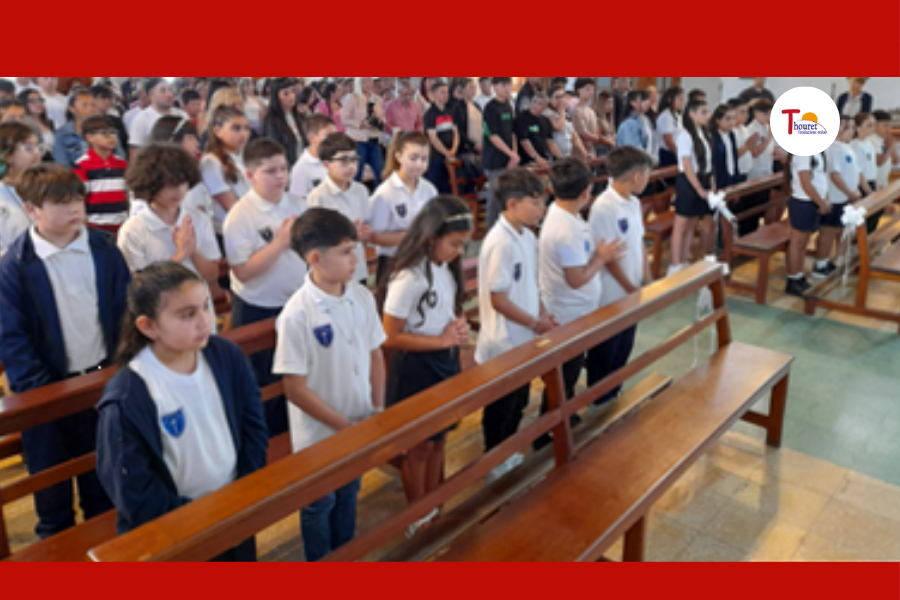
The presence of the Sisters of Charity of Saint Jeanne Antide Thouret in the Argentine Republic dates back to 1968. Today, it continues the evangelisation and promotion of children, adolescents, young people, women and adults through education, which aims to be integral and ecological, both in the Saint Martha Schools of La Plata and Colon and in the day care centre ‘el Campito’ for children and adolescents in Villa Corina, manifesting the love of God the Father, in Jesus and growing in solidarity as a society and as a Church. The Saint Martha School is located in the heart of the horse racing district of La Plata.
Horse racing has been a part of the city’s culture since its origins, and the equestrian district was created because of this industry. It is an area with many stables, so several jockeys with their horses circulate during the morning period. The slope road that crosses the junction of roads 40 and 118, is very busy with public, private, urban and interurban transport as it is a national road that connects La Plata to Buenos Aires. During the afternoon period, the same area is rather inconvenient with respect to safety. Here, the Sisters of Charity operate classes from kindergarten to high school. The school currently accommodates 285 students, from pre-school to high school, mostly from poor families, marked by unemployment, informal jobs, social hardship and complicated family circumstances. In this vulnerable environment, the school represents for many children not only a place of learning, but also a safe space for growing, being protecting and mentored. In fact, the social, economic, cultural and political reality in which Argentina has been living for years directly affects the families of the Saint Martha School community. The economic and employment crisis has led to an increasing family fragility, with many situations of conflictual separation accompanied by hard and long-lasting legal interventions. This framework generates a challenging situation within which the school frequently finds itself acting as an intermediary, trying to manage delicate situations that are inevitably reflected in the pupils’ behaviour, serenity and school performance.
Family disintegration, accompanied by a lack of dialogue and difficulties in educational guidance, is often associated with the spread of worrying phenomena such as the abuse of drugs and the excessive exposure of young people to social networks. These contemporary issues constitute an urgent and complex educational challenge for schools, requiring a structured and an innovative response. The phenomena such as bullying, grooming, online betting, as well as the emergence of new gender ideologies, require an integrative educational intervention that directly involves families and referring adults.
Further elements of concern arise from the current situation of state public schools in Argentina. The Sisters of Charity who live and manage the school in La Plata report that these facilities are frequently in a state of serious structural and managerial crisis, with frequently prolonged interruptions of teaching activities, caused by the constant lack of basic infrastructures (electricity, water, gas) and qualified personnel. Consequently, many poor families who, despite their difficulties, wish to guarantee their children an education that is humanly and Christianly oriented, apply to our schools. These schools offer a warm and safe educational environment, where each student is taken in not simply as a number, but as a unique person with his or her own story and specific individual needs. In the line with Pope Francis’ words expressed in the Global Education Agreement, Saint Martha School makes a concrete commitment “against the culture of waste”, to give human dignity and the ability to relate to each other at the centre of every educational process. The project then arose out of the concrete need to reorganise and expand the school’s spaces, which are currently highly inadequate. The kindergarten has only two small classrooms and insufficient toilets; the secondary school shares classrooms, toilets and recreational spaces with the primary school, resulting to overcrowding, insecurity and uncomfortable layout. The intervention includes enlarging the school, adding accessible toilets, and providing an outdoor area with games and green spaces that can be used both during school hours and for afternoon activities, such as amusement, workshops and socialising. The project also includes complementary training and social actions; the introduction of professional personnel (psychologist/social worker) to offer support to staff, accompaniment to minors and attention to cases of vulnerability. The enlargement of the spaces will allow more effective management and the possibility of setting up new educational services, consolidating the school’s role as a stable and well-established presence in the area.
Sr Elina Bustos, Puerto Triunfo—Paraguay